Updated August 17th, 2026
If you are wondering what your Huntington Woods home is worth, the citywide median is a useful place to start.
It is not where I would finish.
In a six month review of 28 Huntington Woods home sales through August 2026, sale prices ranged from $340,000 to $1.19 million. The median sale price was approximately $508,750, while the average was roughly $571,763.
That is an enormous range for a city as small as Huntington Woods.
And it is exactly why I would never tell a homeowner, “The average Huntington Woods house is worth $X, so your house must be worth about the same.”
Your street matters. Your condition matters. Your architecture matters. Your layout, garage, updates, lot, basement, buyer pool and current competition matter.
Sometimes two homes on the same street with almost the same square footage can sell more than $100,000 apart.
That actually happened this year.
So if the real question is, “What is my Huntington Woods home worth?”, we need to look at the property itself before relying on a citywide number.
Table of Contents
What Is the Average Huntington Woods Home Worth?
For context, I reviewed 28 Huntington Woods residential sales from the most recent six month period through August 2026. These closed sales do not tell us what every Huntington Woods home is worth, but they provide a useful picture of the range buyers have actually paid.
Median sale price: approximately $508,750
Average sale price: approximately $571,763
Median days on market: 5 days
Average days on market: approximately 12 days
Median sale price per above grade square foot: approximately $307
Average sale price per above grade square foot: approximately $319
Individual homes sold from $340,000 to $1.19 million.
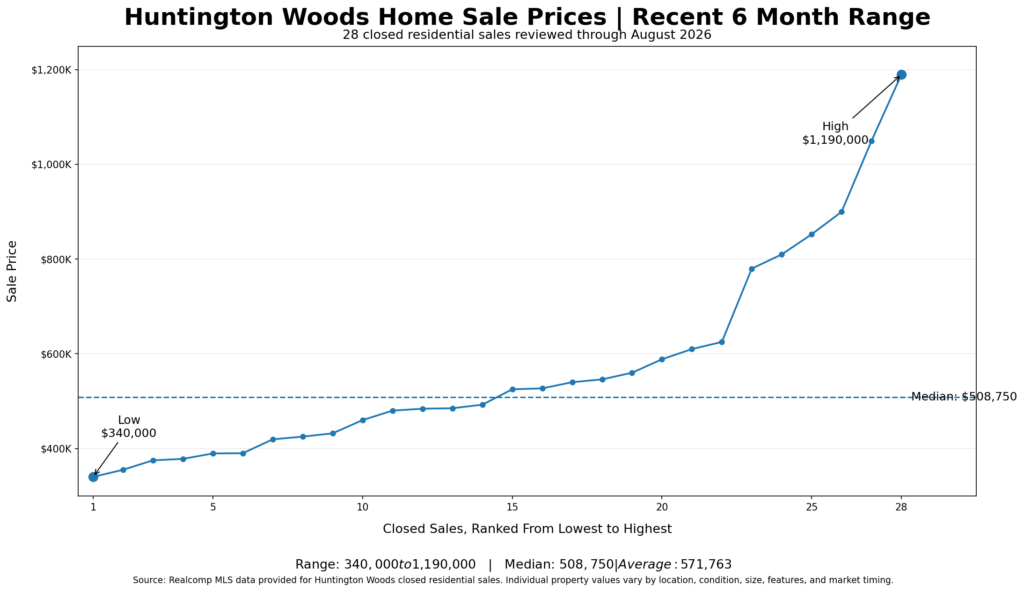
That range should immediately tell us something.
There is no single Huntington Woods home value, or single price per square foot, that can accurately price every house in the city.
A smaller dated bungalow, an extensively renovated interior street home, a large 1920s Colonial, and new construction are all technically Huntington Woods real estate.
They are not interchangeable.
I went deeper into the broader 2026 market statistics in my Huntington Woods housing market report. For an individual homeowner, though, the more important question is how your particular property compares with the homes buyers are actually choosing between.
Why the Huntington Woods Median Does Not Tell You What Your House Is Worth
Huntington Woods has relatively limited turnover.
That creates two challenges when valuing a home.
First, there simply may not be many recent sales that closely match a particular property.
Second, the mix of homes closing during any one month can dramatically move the citywide statistics.
If several smaller homes close in one month, the median can drop.
If a few larger renovated homes or premium properties close the next month, the median can jump.
That does not necessarily mean every Huntington Woods home suddenly gained or lost tens of thousands of dollars.
It may simply mean a different mix of properties sold.
The same problem applies to price per square foot.
Multiplying your square footage by a citywide average may look scientific, but it can ignore the features buyers are actually paying for.
A pair of recent Hart Avenue sales illustrates that better than almost anything else.
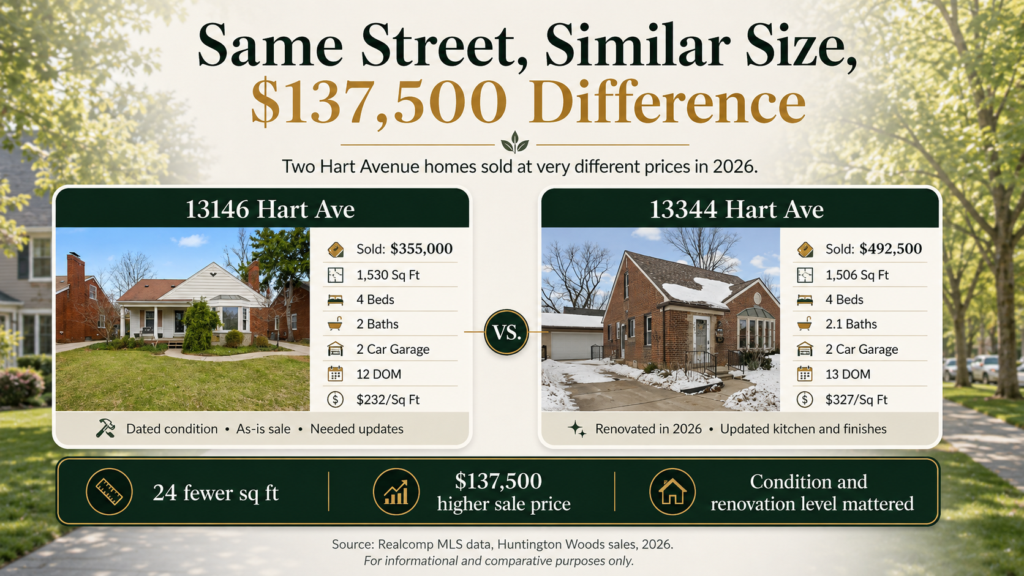
Same Street, Similar Size, $137,500 Difference
Two Huntington Woods homes sold on Hart Avenue in 2026. On paper, they were remarkably similar in size, bedroom count, garage space, lot size, and market time.
Their final sale prices were not.
13146 Hart Avenue
13146 Hart was a 1,530 square foot bungalow with four bedrooms, two full bathrooms, a two car garage, and a partially finished basement.
The home was marketed as an as is opportunity that needed updating. Even so, demand was still there. The listing received multiple offers and ultimately sold for its full asking price of $355,000 after 12 days on market.
That is an important point. A Huntington Woods home does not have to be completely renovated to attract buyers. Condition affects value, but limited inventory can still create meaningful demand for homes that need work.
13344 Hart Avenue
Just down Hart Avenue, 13344 offered a very different presentation.
The 1,506 square foot bungalow had four bedrooms, 2.1 bathrooms, a two car garage, and a similarly sized lot. It had also been substantially updated in 2026, including a renovated kitchen, refinished hardwood floors, updated bathrooms, fresh finishes, and a new garage.
It sold for $492,500 after 13 days on market.
That is $137,500 more than 13146 Hart, even though the updated home was actually 24 square feet smaller and spent almost the exact same amount of time on the market.
What This Comparison Tells Us
The takeaway is not that renovations automatically add $137,500 to a Huntington Woods home.
These are still two different properties, and no single feature explains the entire difference in sale price.
The more useful lesson is that square footage alone clearly does not determine value.
Condition, renovation quality, layout, features, presentation, and the way buyers respond to a particular home can materially change the result.
That is why I would never value a Huntington Woods property by simply taking its square footage and multiplying it by the citywide average price per square foot.
And condition is only one part of the equation.
Location within Huntington Woods can matter too.
Why Your Street Matters in Huntington Woods
I live on 11 Mile Road, so I experience this particular difference every day.
I like living here. I also would not pretend that direct 11 Mile frontage provides the same residential setting as one of Huntington Woods’ quieter interior streets.
There is more traffic. There is more road noise. The experience of pulling out of your driveway is different.
An interior tree lined street can feel much quieter and more residential.
That distinction matters to some buyers, and it is something I would consider when evaluating comparable sales.
It does not mean there is a universal “11 Mile discount.”
That would be too simplistic.
The house itself still matters enormously. So do the lot, garage, condition, layout, improvements and exact competition at the time of sale.
But location within Huntington Woods is not something I would ignore.
A 2026 comparison between 10419 W 11 Mile Road and 12721 Lincoln Drive helps illustrate why.
Nearly the Same Square Footage, Very Different Results
10419 W 11 Mile Road had approximately 1,443 above grade square feet.
12721 Lincoln Drive had approximately 1,450.
Only seven square feet separated them.
The sale prices were very different.
10419 W 11 Mile Road
The 11 Mile property had four bedrooms, two bathrooms and a finished basement.
It also had meaningful updates, including an updated kitchen and bathrooms.
It did not have a garage.
The property originally listed for $395,000 and eventually sold for $375,000 after 61 days on market.
That works out to approximately $260 per above grade square foot.
12721 Lincoln Drive
The Lincoln property had three bedrooms, two full bathrooms, a finished basement and a 2.5 car garage.
It featured an updated kitchen, heated bathroom floors, a large second floor primary bedroom, additional finished lower level living space, landscaped outdoor areas and newer heating and cooling equipment.
It listed for $529,000.
After five days on the market and an offer deadline, it sold for $540,000.
That is approximately $372 per above grade square foot.
The difference in sale price was $165,000.
Would it be accurate to say that Lincoln Drive itself created a $165,000 premium?
No.
There are too many other differences between the homes.
But it would be equally inaccurate to look at two homes separated by seven square feet and assume they should sell for approximately the same amount.
That is the point.
Good valuation requires looking at the entire property.
If you want to see how much those differences can matter, I break down several recent sales in my guide to determining a Huntington Woods home value.
What Creates Seven Figure Value in Huntington Woods?
The upper end of the market makes the same point from another direction.
26255 Pembroke Road sold for $1.19 million in July 2026.
The 1927 Colonial offered approximately 3,361 above grade square feet and more than 4,200 estimated finished square feet across the home.
It included five bedrooms, 3.1 bathrooms, a two car garage, four finished levels, substantial architectural character, a large primary suite, gracious formal living spaces, a mudroom, finished lower level space, updated outdoor areas and access to one of Huntington Woods’ private parks.
The property was listed at $1.15 million and sold for approximately $40,000 over asking.
That is not simply a larger version of a $400,000 bungalow.
It appeals to a different buyer, competes against a different group of properties and occupies a different part of the Huntington Woods market.
Architecture, scale, condition, location and scarcity all come together.
That is why the city can support a $340,000 sale and a $1.19 million sale within the same six month period.
The 7 Things I Look at When Valuing a Huntington Woods Home
When someone asks me what their Huntington Woods home is worth, I usually want to understand seven things before giving a meaningful answer.
1. The Exact Location
Not just Huntington Woods.
The actual street and setting.
I look at interior versus major road frontage, traffic exposure, surrounding homes, lot placement and nearby community amenities.
Proximity to places such as Burton Elementary, the Recreation Center, parks and other neighborhood destinations can matter to individual buyers because of convenience.
The important thing is understanding how the location compares with the most relevant recent sales.
2. Updates and Overall Condition
This is one of the first things I ask a homeowner about.
What have you done since you purchased the house? Kitchen? Bathrooms? Roof? Windows? Mechanical systems? Flooring? Addition? Finished basement? Cosmetic improvements?
I also want to know what may need replacement in the next few years.
The Hart Avenue comparison shows why.
Two extremely similar homes on the same street produced dramatically different sale prices, with condition and renovation level among the most obvious differences.
3. Architecture and Scarcity
Huntington Woods is not a subdivision where every house was built from three floor plans.
That is part of its appeal.
Bungalows, Colonials, Tudors, ranches and other architectural styles can create different buyer pools.
Certain housing types also come to market less frequently.
For example, if I am valuing a desirable ranch, I pay close attention to the limited number of comparable ranches available because scarcity can affect buyer behavior.
That does not mean every ranch automatically deserves a fixed premium.
It means the relevant comparable set may be different.
4. Size and Functional Layout
Above grade square footage matters.
How that square footage is used matters too.
A home with an excellent primary suite, additional bathroom, open kitchen, functional bedroom placement or strong first floor flow may appeal differently than another house with the same number of square feet.
Buyers experience rooms, not spreadsheets.
5. Basement and Usable Living Space
Finished lower level space can be extremely useful.
An office, recreation room, gym, full bathroom or entertainment space can improve how a home functions.
But I would not automatically value basement square footage at the same rate as above grade living space.
It has to be evaluated in context.
6. Garage, Lot and Outdoor Space
Garage size can matter substantially in a neighborhood with older housing stock.
So can the lot, landscaping, patios, decks, fencing and how the property connects to the outdoors.
Again, no single feature has one universal dollar adjustment.
The buyer pool tells us what matters most at that moment.
7. Current Competition
This is the factor automated valuations can struggle with in real time.
What will buyers see when your home actually hits the market?
If three very similar homes are competing for the same buyer, that affects strategy.
If your home is the only realistic option of its type, scarcity can create leverage.
Value is historical, but pricing strategy also has to be current.
Why Price Per Square Foot Can Be Misleading
Price per square foot is one of the easiest real estate statistics to understand.
It is also one of the easiest to misuse.
Across the 28 Huntington Woods sales I reviewed, the median was approximately $307 per above grade square foot.
The individual sales ranged from roughly $232 to more than $400 per square foot.
Imagine two 1,600 square foot homes.
Using $307 per square foot would put both near $491,000.
But what if one needs a new kitchen, baths and mechanical systems while the other was completely renovated?
What if one has no garage and the other has two cars?
What if one fronts a major road and the other sits on a quiet interior block?
What if one has a highly functional primary suite and the other has a difficult layout?
Those homes may not belong at the same price at all.
Price per square foot should help us understand a sale. It should not replace understanding the property.
A Huntington Woods home value should be built from the property outward, not from a citywide average inward.
What Zillow and Online Home Estimates Can Tell You
I do not think automated home estimates are useless.
They can be a helpful starting point.
They provide homeowners with an immediate reference and can help show broader value trends.
But an algorithm does not walk through your house.
It may know that you have 1,600 square feet.
It may not fully understand how good your kitchen renovation actually is.
It may know that you have three bedrooms.
It may not understand that one of them functions poorly for today’s buyers.
It may see your address.
It cannot experience the difference in traffic noise between locations the way a buyer experiences it during a showing.
It may also have a difficult time accounting for a housing type that rarely sells because there are fewer recent examples to model.
So if Zillow says your house is worth $550,000, I would not automatically say Zillow is right or wrong.
I would ask:
What has been updated? What needs work? Where exactly is the property? What has sold nearby that a buyer would genuinely compare against it? What is currently for sale? And what does your home offer that those properties do not?
That is how I would start answering whether the actual market is closer to $475,000, $550,000 or $650,000.
How I Would Determine Your Huntington Woods Home Value
If you asked me to evaluate your house, I would start with the property rather than an automated number.
First, I would review the most relevant recent Huntington Woods sales.
Then I would narrow those sales based on location, architecture, size, layout, condition and features.
I would look at what is currently listed because those homes are your competition, not just historical data.
I would want to see your house in person when possible.
A walkthrough often answers questions that public records cannot.
Then I would look at the property from two perspectives.
What does the data support?
And:
How is today’s buyer likely to react when this home enters the market?
Those two answers should work together.
The goal is not to give a homeowner the highest number because it sounds good.
The goal is to determine a realistic range and then build the best possible strategy for positioning the property within that range.
If you are thinking about selling, you can also read more about my approach on my Sell With Keith page or my broader Huntington Woods Realtor guide.
Should You Renovate Before Selling a Huntington Woods Home?
Sometimes.
But this is another area where I would not give every homeowner the same answer.
The difference between the two Hart Avenue sales shows that buyers can pay substantially more for a well updated property.
That does not mean every renovation produces a dollar for dollar return.
If you are preparing to sell, I would rather identify the improvements that affect presentation and buyer objections than automatically recommend a major remodel.
Sometimes that means paint, flooring, repairs, landscaping and cleaning.
Sometimes a larger improvement may make sense.
Sometimes the better financial decision is to sell the home in its current condition and let the next owner renovate it.
The answer depends on the house, the likely buyer and the cost of the work.
The Bottom Line on Huntington Woods Home Values
There is no single Huntington Woods home value.
There are Huntington Woods homes, each competing in a specific market.
Recent sales show just how different those outcomes can be.
Two Hart Avenue bungalows of almost identical size sold $137,500 apart.
Two homes within seven square feet of one another on 11 Mile and Lincoln sold $165,000 apart.
And the broader six month market ranged from $340,000 to $1.19 million.
That is why I believe the best way to value a Huntington Woods home is to start with the property itself.
The citywide statistics give us context.
The comparable sales give us evidence.
The house, street, condition and current buyer pool give us the answer.
Curious What Your Huntington Woods Home Is Worth?
If you own a home in Huntington Woods, I can prepare a property specific value analysis using recent comparable sales, current competition, your home’s condition, updates, location and the market that exists right now.
What Is My Huntington Woods Home Worth?
Huntington Woods Home Value FAQs
How accurate are online home value estimates in Huntington Woods?
Online estimates can provide a useful starting point, but Huntington Woods contains a wide range of home sizes, architectural styles, locations and renovation levels. A property specific analysis using relevant comparable sales and current competition can provide additional context that a citywide automated estimate may miss.
How much does renovation affect a Huntington Woods home value?
The impact varies by property and renovation quality. In one 2026 example, two similarly sized Hart Avenue bungalows sold $137,500 apart, with the more extensively updated property commanding the higher price. That does not mean every renovation produces the same return, but condition and presentation can materially affect buyer demand.
Does living on 11 Mile affect a Huntington Woods home value?
Major road frontage can influence some buyers because of traffic and noise, but there is no universal dollar adjustment. The home’s condition, garage, size, layout, lot and competing properties also matter. An 11 Mile sale should therefore be compared carefully rather than automatically treated the same as an interior street property.
What is the best way to find out what my Huntington Woods home is worth?
Start with recent comparable Huntington Woods sales, then adjust the analysis for your exact street, condition, renovations, architecture, size, layout, garage, lot and current competing inventory. An in person walkthrough can also identify features or issues that public records and automated estimates may not capture.
Sources and Market Data
Market statistics and property examples in this article were compiled from Realcomp MLS data for Huntington Woods residential sales through August 2026. Calculations and comparisons in this article are my own analysis of the referenced MLS sales data.
The six month analysis included 28 closed Huntington Woods sales and was used to calculate the sale price range, median and average sale price, market time and above grade price per square foot figures discussed above.
Individual property examples include MLS records for 13146 Hart Avenue, 13344 Hart Avenue, 10419 W 11 Mile Road, 12721 Lincoln Drive and 26255 Pembroke Road.
Market statistics represent a snapshot in time. Huntington Woods has relatively limited transaction volume, so averages and medians can change meaningfully depending on the homes that sell during a particular period. No citywide statistic should be treated as a valuation of an individual property.